

Key Takeaways:
- Weather forecasting is a key part of planning renewable energy development, and AI can aid in this process by pulling together all the weather data and making long-term predictions.
- AI can combine multiple data sets to more accurately predict weather patterns and renewable energy production.
- Using deep learning, AI can identify patterns in time series data on energy generation and weather conditions, much like a human brain can.
Artificial intelligence (AI) has become ingrained in many of our lives. Whether you use generative AI to edit or create content or a more complex AI model to perform in-depth repetitive tasks to free up human labor, AI is here to stay.
AI has many uses, including uses related to renewable energy. Because most renewable energy relies on weather, proper weather forecasting is a must. Fortunately, AI weather forecasting can handle most of the predicting and planning.
We take a deep dive into the world of AI weather forecasting and how it helps with renewable energy generation.
What AI Models Are Most Effective for Forecasting Renewable Energy Generation?
Several AI models exist for renewable energy forecasting, but the most common are neural networks and ensemble models.
Neural networks learn patterns from large datasets through layers of interconnected nodes. They recognize relationships in non-linear data. And most energy generation forecasts use non-linear data, making them great for predicting energy output based on historical generation patterns and meteorological data.
Ensemble models combine many algorithms to improve prediction accuracy. An ensemble model helps mitigate individual model weaknesses, resulting in a more detailed and reliable forecast.
Other models, such as support vector machines (SVM) and decision trees can also play important parts in weather forecasting AI models. SVMs excel in high-dimensional spaces and are effective when dealing with limited datasets. Decision trees help AI models interpret data and understand energy generation’s most influential factors.
Hybrid models combine various algorithms and are gaining traction in AI weather models and renewable energy because they lean into the strengths of multiple approaches.
A hybrid model may combine neural networks with decision trees, using the neural network’s ability to capture complex patterns while delivering the interpretability of a decision tree model. This enhances forecasting accuracy and helps stakeholders make informed energy management and policy planning decisions.
Enter your ZIP Code and compare electricity rates
How Does AI Manage Differing Data Sources, Such as Weather Data, Satellite Imagery, and Historical Generation Data?
Using varying data sources helps enhance AI forecasting models’ accuracy.
AI algorithms can receive many data inputs, such as weather data, satellite imagery, and historical energy generation data. This allows the AI models to create comprehensive datasets that capture the complex nature of a renewable energy forecasting system.
AI systems often use data preprocessing techniques to standardize and normalize the vast information they receive to manage all these data types.
Historical weather data often comes from different sources with varying frequencies and formats compared to other data. When AI can align this data, each input will make a meaningful contribution to the prediction process.
AI systems can also use advanced data fusion techniques to merge information from various sources into a single dataset to enhance performance. This helps create accurate forecasts and allows for real-time decision-making, leading to more responsive energy management practices.
Machine learning models can also use feature engineering to pull specific characteristics from the raw data.
For example, satellite imagery can give you insight into land use and vegetation cover, which are critical for finding the ideal solar panel placement for energy efficiency. An AI system can use feature engineering to transform visual data into quantifiable features. This allows the AI model to improve its forecasting skills and better predict energy output based on environmental conditions.
What Role Do Advanced Techniques Like Deep Learning and Reinforcement Learning Play in Renewable Energy Forecasting?
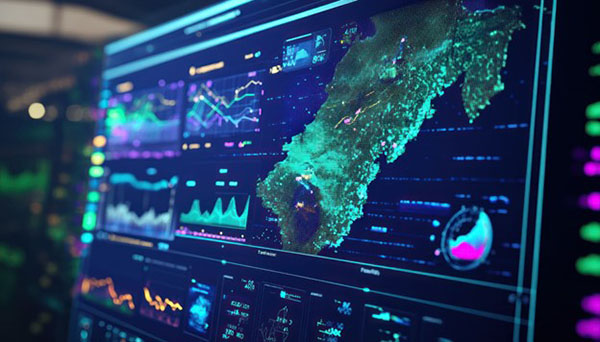
Deep learning and reinforcement learning are advanced techniques that impact renewable energy and global weather forecasting.
Deep learning, an offshoot of machine learning, uses neural networks with multiple layers to mimic a human’s decision-making process. This is useful when identifying patterns in energy generation and weather conditions.
Energy providers can use complex AI algorithms to better understand the impact of cloud cover, temperature changes, humidity levels, heat waves, and other weather phenomena on renewable energy production.
Reinforcement learning trains AI algorithms to make decisions based on trial and error. In energy forecasting or meteorology, reinforcement learning helps prediction strategies by learning from new data and adjusting as needed. This allows for real-time energy distribution adjustments so energy supply meets demand.
Reinforcement learning can also simulate many scenarios and help develop energy storage and grid management strategies. This can lead to a more reliable energy infrastructure.
Deep learning and reinforcement learning significantly improve forecasts’ reliability so the energy sector can anticipate supply variations and tweak energy distribution strategies.
These advanced methods enhance prediction accuracy and help energy providers install renewable energy into existing grids. This addition of renewable energy can contribute to cleaner energy production and help slow or reverse climate change around the Earth.
How Does the Weather Forecast Accuracy Impact the Reliability of AI-Driven Renewable Energy Predictions?
The accuracy of meteorologists’ weather forecasts is crucial in driving AI-driven renewable energy prediction accuracy. Most renewable energy generation is highly dependent on the weather, such as sunshine and wind speed. Discrepancies in weather agencies’ weather forecasts versus real-world weather can significantly impact the actual expected energy output compared to predictions.
AI weather models require accurate and timely weather data to make their predictions as precise as possible. If the incoming weather data is flawed or imprecise, the resulting energy forecasts will likely run into the same issues with imprecision, which undermines predictions and planning.
This is why it’s important for AI systems to continuously evolve and add more sophisticated weather modeling techniques that help improve their prediction reliability.
By integrating various weather prediction models, AI systems can mitigate the impact of an individual model’s inaccuracies, improving performance and accuracy.
What Are the Best Data Sources for Real-Time and Long-Term Weather Forecasting in Renewable Energy Models?
Several data sources impact real-time and long-term weather forecasting for renewable energy models. These data sources include:
- Government meteorological organizations: The National Weather Service (NWS) and the European Centre for Medium Range Weather Forecasts (ECMWF) provide weather forecasts that AI models can use to predict renewable energy output.
- Private weather services: Numerous organizations create and distribute weather data. These organizations often have high-resolution data and the ability to make accurate predictions. These sources are great for local-level weather predictions, which is important for solar and wind energy projects that need precise weather predictions.
- Satellite imagery: Satellite data and imagery can contribute to understanding weather patterns. AI systems can combine satellite data and imagery with ground-level meteorological readings to create a more complete view of weather conditions. This hybridized data leads to improved forecasting outcomes.
How Can AI Models Incorporate Uncertainties in Weather Data to Improve Prediction Robustness?
Predicting the weather is challenging, as there’s always uncertainty. We’ve all seen the “50% chance of rain” prediction, which leaves room for a fair amount of chance. By incorporating uncertainties into the weather data that AI systems use, we can enhance the robustness of AI forecasting models.
We can incorporate this uncertainty in several ways, including:
- Probabilistic modeling: This provides a range of possible outcomes instead of single-point prediction. The method allows AI systems to gauge risk and make more informed decisions based on several scenarios.
- Ensemble forecasting: This is when an AI system generates multiple models using slightly different initial conditions or input AI systems can quantify uncertainty and provide more reliable predictions by analyzing all the variables across the ensemble forecasts.
- Machine learning techniques: Various machine learning techniques, such as Bayesian inference, which focuses on probabilities, allow AI models to refine their predictions as they receive new data. This adaptability helps AI models remain resilient despite unpredictable weather changes.
How Do AI Models Account for Cloud Cover, Temperature, and Irradiance in Solar Power Prediction?
AI models use a wide range of techniques to account for variables like cloud cover, temperature, and the amount of solar energy reaching the Earth’s exosphere in solar power predictions. As you’d expect, these are important factors in solar energy generation. Including them in AI weather models is essential for precise renewable energy production forecasting.
Data-driven AI models use historical datasets to establish relationships between these variables and how they affect energy output. AI systems can use various atmospheric data to predict how cloud cover or temperature changes may influence solar energy entering the Earth’s atmosphere, impacting renewable energy generation.
Plus, AI weather forecasting can use convolutional neural networks (CNNs) to process patterns in satellite images to analyze cloud cover. This allows for real-time assessment of solar generation potential, helping create timely and context-aware forecasts so energy producers can respond quickly to changing weather conditions before they happen.
AI Weather Forecasting Can Help Push Renewable Energy to a New Level

Renewable energy has a large role in future electricity production, as we aim to reduce our carbon footprint and fossil fuel use.
To make the shift, we must pivot to new technology like predictive and generative AI. This technology can help energy producers predict weather patterns and develop the most efficient renewable energy plans without relying on significant human input.
Brought to you by energysavings.com
All images licensed from Adobe Stock.