
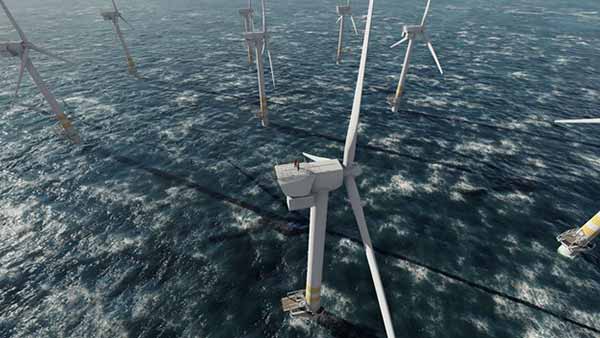
The U.S. federal government’s sale of six wind farm leases for New York and New Jersey has raised a record $4.37 billion at auction. The amount is the largest-ever offshore energy lease in United States history, including oil and gas lease sales.
Some 488,000 acres of shallow waters between New York and New Jersey, known as the New York Bight area, will become home to wind turbines. The wind farms could provide up to 7 gigawatts of clean energy. That’s enough to power up around 1.5 to two million homes.
Leading the bidding was Bight Wind Holdings, paying $1.1 billion for a 125,964-acre area off the New Jersey coastline.
New York Bight Auction the First of Many
New York Bight was the first offshore wind lease sale by the U.S. Bureau of Ocean Energy Management (BOEM) under President Joe Biden.
Biden’s administration has promised 30 gigawatts of offshore wind energy installations across the United States by 2030. Officials say the plans, part of its broader climate change policy, offer a $109 billion revenue opportunity for businesses in the supply chain over the next decade.
Offshore wind farm projects in federal waters are already pushing forward under the current regime. Massachusetts has approval for an 800-megawatt offshore wind farm called Vineyard Wind, while New York’s 130-megawatt South Fork Wind project has also been given the green light.
The BOEM wants to review a further 16 offshore wind farm plans before 2025, adding a potential 22 gigawatts of clean energy to the U.S. power grid. Further offshore wind lease sales are earmarked later this year for the Carolinas and California, with Central Atlantic, the gulfs of Maine and Mexico, and offshore Oregon in the pipeline, too.
Secretary of the Interior Deb Haaland said, “This week’s offshore wind sale makes one thing clear: The enthusiasm for the clean energy economy is undeniable, and it’s here to stay.”
Offshore Wind Power in the U.S. Given a Timely Boost
In 2019, the United States accounted for 21% of the world’s wind-generated electricity, second only to China.
In 2020, 8.4% of U.S. electricity came from wind power — the highest of any renewable source. Some 42 states counted wind-powered electricity among their energy mix, led by Texas, Iowa, Oklahoma, Kansas, and Illinois.
However, offshore wind capacity remains embryonic in the U.S. despite its great potential. The nation currently has just two working offshore wind facilities. Rhode Island’s produces 30 megawatts and Virginia’s has a 2,600-megawatt capacity, a tiny amount compared to New York Bight.
Onshore Wind Projects Experience Turbulence
Onshore wind power still faces opposition in some areas. Last week, the Bureau of Land Management said it has turned down the Walker Ridge Wind Energy Project application in California.
Colusa Wind LLC’s plan to build 42 wind turbines over 2,272 acres of land at Walker Ridge faced opposition. Locals feared environmental damage, impact on wildlife, and other issues caused by turbines measuring up to 676 feet tall.
The refusal brings into focus BOEM’s inclusion of the commercial fishing industry, American Indian tribes, underserved communities, and the public with offshore wind farm planning. The New York Bight lease acreage was reduced by 72% to avoid conflicts with ocean users and minimize environmental impacts.
Offshore Wind Could Become Cornerstone of U.S. Renewables
Research shows offshore wind electricity production generally peaks in the afternoon and evening, matching peak consumer demand times. Onshore wind tends to produce more energy at night.
The U.S. is estimated to have 2,000 gigawatts of offshore wind capacity. The New York Bight lease auction shows the enormous appetite for offshore wind power. It represents a small but growing ability to tap into the tremendous electricity-generation potential in the United States’ coastal waters.
However, as the money starts to flow into offshore wind markets, investors and the BOEM must continue to heed environmental and cultural impacts. The race for clean energy cannot leave a trail of damaged ecosystems as its legacy.
Opinion writer: Tom Shearman
The opinions, beliefs, and viewpoints expressed by the various authors do not necessarily reflect the opinions, beliefs, or viewpoints of Interactive Energy Group, LLC (IEG) or its parent companies or affiliates and may have been created by a third party contracted by IEG. Any content provided by the bloggers or authors are of their opinion and are not intended to malign any individual, organization, company, group, or anyone or anything.
Brought to you by energysavings.com
All images licensed from Adobe Stock.
Featured Image