
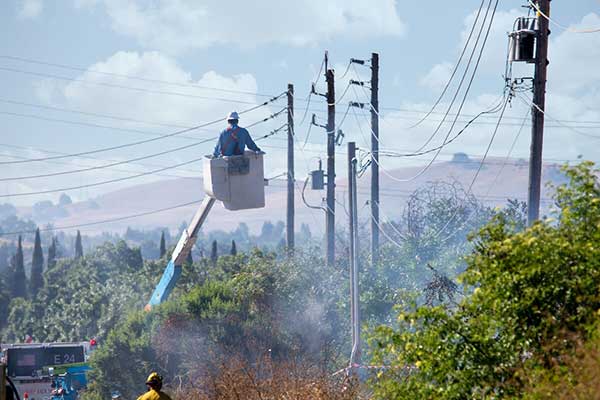
This week saw another massive fire linked to California’s state utility Pacific Gas & Electric; the company says it will follow through on a promise to place transmission lines underground to prevent future disasters. In more positive news, the world’s greatest automobile brands have set themselves a deadline of 2030 for achieving full or partial electrification of their vehicles.
Pacific Gas & Electric Involved in California Fire
A major fire in California that has been raging for over a week began when a pine tree fell on a power line of the state’s largest utility provider Pacific Gas & Electric (PG&E).
The fire is so huge that it is generating its own weather system with clouds that could cause lightning.
Other states have been called in to help fight the blaze, which has required more than 5,000 firefighters.
PG&E told regulators that an accident involving one of its power lines was responsible for the blaze. The company has said it will spend billions on placing 10% of its transmission and distribution lines underground to avoid another disaster. Previously, the company had resisted doing so because of the high cost involved.
Major Car Brands Plan to Be Fully Electric by 2030
Manufacturers of Mercedes, Fiat, and Audi are among a growing group of major car brands that have expressed the intention to be fully or almost fully electric by 2030.
Daimler, which manufactures Mercedes, intends to spend 40 billion euro to make the transition. It says it plans to make the chassis, motor, and wheels of that car 100% electric by 2025.
Some divisions of the Stellantis group, which manufactures Fiat, Chrysler, and Jeep have also announced that they expect their vehicles sold in Europe to be 100% electric by 2030.
The German carmaker Volkswagen is aiming to displace Tesla as the leading EV manufacturer and wants half of all its vehicle sales to be electric by 2030. It is also hoping to make all of its Audi cars fully electric by 2033. The carmaker is investing 73 billion euros toward the transition, some of which will be spent on installing charging stations around the world.
Volvo plans to cease production of all internal combustion engine and hybrid vehicles by 2030, and the Jaguar brand owned by Tata expects to be 100% electric by 2025.
Toyota intends to launch several models that are 100% electric by 2025 and says it expects 10% of European sales to remain internal combustion vehicles.
Carbon Capture Projects Promise to Aid Environment in Midwest
Navigator CO2 Ventures and Summit Carbon Solutions want to build pipelines in the Midwest that will capture carbon emissions from ethanol refineries and sequester them. The proposed carbon capture and sequestration projects would run through Iowa, South Dakota, Minnesota, and Nebraska.
The projects are expected to cost billions of dollars and create thousands of construction jobs. The announcement comes in the wake of the Biden administration’s decision to increase companies’ tax credits by $50 for every metric ton of carbon they sequester.
However, some landowners in the Corn Belt are skeptical and fear the possibility that there may be a spill from the pipelines. Opponents like Greenpeace are urging a greater focus on renewable energy rather than on technologies that prolong and perpetuate fossil fuels.
Supporters of the projects, on the other hand, say they will help keep industries alive that the region depends on. The two carbon capture companies also say the projects will have the effect of taking millions of cars off of the road each year.
U.S., Germany reach agreement on Nord Stream 2

The United States and Germany have finally reached an agreement on the Nord Stream 2 pipeline that will carry gas from Russia to Europe under the Baltic Sea. The pipeline, which will be 1,230-kilometers (km) long, will double gas exports from Russia to Germany.
Less than 100 km of the $11 billion pipeline remains to be built.
Opposition to the pipeline arose partially from fears that Russia would use the undersea pipeline to hurt the Ukraine economy by eliminating it as a transit country.
As part of the agreement between Germany and the U.S., 200 million euros will be invested to ensure energy security in Europe and the Ukraine.
Since the pipeline runs under the sea rather than over land, Ukraine will be losing billions of dollars a year in transit fees. The U.S.-Germany agreement guarantees that the Ukraine will receive compensation for the lost transit fees until 2024.
U.S. Power Sector Emissions Fall by 10%
Between 2019 and 2020, the U.S. power sector saw a fall in emissions of 10%, partly due to the pandemic but also because of greater use of natural gas and renewables.
A recently released report said it was part of a long-term trend in which use of wind, solar, and geothermal power almost doubled between 2000 and 2020. This increased reliance on renewables resulted in a 37% decline in power sector emissions over the two decades, even as the economy grew by 40%.
Wind, solar, geothermal, hydro, and nuclear power now provide almost 40% of the country’s electricity supply.
Some power providers would like to see a target set for 80% clean electricity by 2030, and recent research suggests that the country can achieve 95% clean power by 2035.
G20 Fails to Agree on End to Coal Plants
G20 environment ministers were unable to reach an agreement on ending the use of coal-fired power plants and their construction.
Word choice seemed to be the sticking point in the negotiations with some countries, including China, objecting to the language chosen to express the goal of eliminating coal use or its funding.
China makes widespread use of coal fuel and is building or has plans to build several new coal-fired power plants. The International Energy Agency expects a 3% growth in such plants next year.
The U.S. and Europe have been steadily using less coal for power over the years. The Paris Agreement’s goal for reducing global warming requires that substantially more cuts in coal use be achieved.
G20 members will continue discussions on the way forward to phasing out coal, which they say the majority have agreed is necessary and urgent. They will try to reach an agreement at the G20 leaders’ conference in Rome in October, which takes place just before the COP26 climate summit in Scotland.
Energy Efficiency Regulations Stop Computer Sales

Dell recently informed customers in California, Colorado, Hawaii, Oregon, Vermont, and Washington that it will no longer be shipping some types of its computers to them because of state regulations regarding energy efficiency.
The company’s website stated that any orders from those states will be canceled.
Concerns about the amount of energy used by computing have been documented for several years. It is estimated that by 2040 the amount of energy used for computing will exceed the world’s energy production, as computing energy consumption continues to grow exponentially.
California implemented computer energy efficiency standards in 2016, and other states later followed.
The regulations cover desktop computers, mobile gaming systems, and other devices.
Dutch Project to Combine Solar and Farming
Vattenfall, a Swedish energy firm, has received funding from the Dutch Ministry of Economic Affairs to develop a project in the Netherlands where crops and solar panels work together to produce energy.
Though a final decision to proceed with the project has not yet been made, construction will begin next year once it is approved.
The project is important in the Dutch context where large-scale deployment of renewables on agricultural land is considered problematic. Vattenfall’s technology does not require land to be set aside for solar panels.
Instead, its technology will alternate with rows of organic crops and use double-sided solar panels to optimize uptake and production of solar energy. The panels also rotate with the sun to catch the sunlight.
The four-year pilot project, known as Symbizon, will involve research organizations that will monitor the project for crop and energy yield as well as ease of use for farmers.
The idea is similar to agrophotovoltaics, a technology used by some farmers since the 1980s.
Israel Commits to Cutting 85% of Carbon Emissions
Israel has announced that it will cut its emissions by 2050 by 85% relative to 2015 levels, as it seeks to become a more efficient and cleaner low-carbon economy.
The country is looking to cut emissions in the transport, electricity, and municipal waste sector.
An intermediary target of 27% emissions reduction by 2030 was also announced.
The goals have been described by Israel’s prime minister as revolutionary and historic. Government ministers will now have to vote on the targets.
Opinion writer: Jewel Fraser
The opinions, beliefs, and viewpoints expressed by the various authors do not necessarily reflect the opinions, beliefs, or viewpoints of Interactive Energy Group, LLC (IEG) or its parent companies or affiliates and may have been created by a third party contracted by IEG. Any content provided by the bloggers or authors are of their opinion and are not intended to malign any individual, organization, company, group, or anyone or anything.
Brought to you by energysavings.com
All images licensed from Adobe Stock.
Featured image