
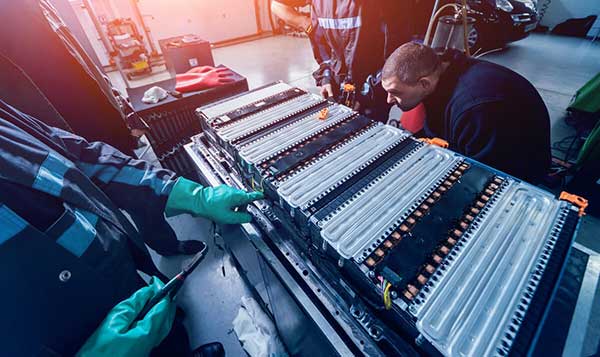
A Japanese carmaker is giving the U.K.’s electric car industry a boost with a 1 billion pound investment to expand car production and establish a gigafactory to produce car batteries.
Nissan to Build Gigafactory in the U.K.
Nissan and two partners will invest 1 billion pounds to establish a facility to build both electric vehicles and batteries – a “gigafactory” – in the U.K.’s northeast.
Nissan’s partner Envision AESC will be responsible for building the gigafactory where batteries will be produced for electric vehicles. The gigafactory in Sunderland will have the capacity to produce 9 gigawatt hours of batteries annually by the end of the decade.
The two projects are expected to generate more than 1,000 new jobs, and the British government has promised funding support for it.
Britain’s Prime Minister Boris Johnson hailed the development as a vote of confidence in the U.K. since its leaving the EU.
It is hoped that the new plant will be up and running by 2024.
IEA Warns About Climate Impacts From Gas Demand
After a drastic fall-off due to the coronavirus pandemic, demand for gas is expected to steadily rise over the next few years at a rate that is incompatible with keeping global temperature increase below 1.5 degrees Celsius.
The International Energy Agency said a strong rebound for gas can be expected unless governments act proactively to contain the demand.
Recent high temperatures have also pushed up demand for gas, as more people have increased their use of air conditioning.
The IEA also noted that prices for gas in both Europe and Asia are at their highest within the past seven years.
Keystone XL Pipeline Company Wants Compensation From U.S.
TC Energy has filed a notice of intent that it will be pursuing a $15 billion claim against the U.S. government over the halting of the Keystone XL pipeline project.
The Canadian company was building the Keystone XL pipeline to carry oil from Canada to the U.S. but cancelled the project after President Joe Biden rescinded a key permit allowing the construction of its 1,200-mile pipeline. He said the project was not in keeping with U.S. interests. Environmentalists and indigenous groups had said the pipeline would do considerable environmental harm, including contributing to climate warming.
But TC Energy in its claim said the president’s action was in breach of the North American Free Trade Agreement and had resulted in financial losses as well as leading to the layoff of 1,000 workers.
The project’s cost had grown from $5.4 billion to $9 billion since the announcement of its construction in 2008.
Massachusetts Climate Law to Use Social Values Pricing

A climate law that requires Massachusetts to achieve net-zero emissions by 2050 took effect at the end of June and is expected to incorporate social values pricing to encourage greener lifestyles.
The law was signed in March and lays the groundwork for several changes to benefit the environment. Among these is the social values pricing initiative that rewards consumers for replacing appliances that run on fossil fuels with appliances that use other forms of energy.
The law requires the Department of Public Utilities to look beyond issues of reliability and affordability when reviewing contracts with suppliers and drafting policy. It must now also factor in concerns such as cybersecurity, equity, and reduction of greenhouse gas emissions.
Energy efficiency standards for appliances and standards for clean energy technologies are also expected to be determined under the law.
Massachusetts is hoping to halve its emissions by 2030, and some state activists are pushing for 100% clean heating and transportation by 2045.
Protesters Occupy Enbridge Office Overnight in the U.S.
About 70 protesters descended on Enbridge’s offices in Waltham, Massachusetts, singing and playing music. They demanded that Enbridge management respond to their concerns about the construction of the Line 3 pipeline. The protesters also called for a compressor station in Weymouth to be shut down, among other issues.
The Line 3 pipeline is being built to carry crude oil from Canada to Wisconsin through Minnesota.
The protesters said they were in solidarity with the Minnesota indigenous Giniw Collective and accused Enbridge of perpetrating “crimes against humanity”.
Though most of the protesters left the building before nightfall, 13 of them chose to spend the night. Ten subsequently left, but three remained, demanding to be heard by Enbridge officials. These three were then arrested for trespassing.
Enbridge responded in a statement stating that it respects people’s right to “express their views legally and peacefully” but will not condone illegal activity.
Fire Burns in Gulf of Mexico
An underwater pipe leak from Mexico’s oil company, Pemex, led to a fire on the water’s surface in the Gulf of Mexico for just over five hours on July 2.
The state-owned oil company was able to extinguish the fire, which occurred near one of its oil platforms, without any recorded injuries. Pemex has shut the valves of the pipeline and says it is investigating the cause of the fire.
Greenpeace Mexico reacted to the incident saying it was clear evidence that the government’s commitment to the fossil fuel industry was a dangerous one.
U.S. Oil Company Cedes Control of Discovery to Pemex
Mexico’s government informed a U.S. oil firm that a field it discovered in 2017 will be operated by the state-owned oil company, Pemex, after a years-long struggle over control of the discovery.
Houston company Talos Energy Inc., which led the consortium that discovered the oil field Zama in Mexico’s Campeche Bay, was recently informed about the decision by letter from the Mexican authorities.
The Zama field is estimated to hold 1 billion barrels of oil equivalent, and the struggle over its ownership began when it was discovered that it partially lay in a reservoir owned by Pemex. In 2018, it was agreed that Talos and Pemex would cooperate on matters pertaining to the field.
Then, in May this year, Talos announced that Pemex held the majority stake in the field of 50.4%.
The decision to give control of the field to Pemex is seen as part of a trend toward nationalizing the oil and gas industry since Mexico’s President Andres Manuel Lopez Obrador came to power. But some observers question whether Pemex is competent to manage the field successfully.
Rebel-Held Towns in Syria Depend on Solar Energy

In rebel-held areas in Syria, there is little hope of receiving electricity from state providers. So citizens in those communities have taken to installing solar panels to supply some of their energy needs.
One farmers’ cooperative spent $4,000 on 200 solar panels to supply energy for their three-acre cooperative farmland. Farmers are among the chief buyers of solar panels, says one businessman who sources panels from Turkey, China, and Germany. He said the panels will last up to 20 years.
A University College London report said that 8% of Syrians depend on solar energy as the main source of power supply for their homes. The same study found that a third of the Syrian population uses solar as a secondary source for charging batteries and lighting.
The civil war had drastically reduced the normal power supply, and now that life has regained some semblance of normalcy, there has been an increase in the use of solar power, which is expected to continue.
Syrians find solar panels cheaper to operate than the diesel generators they used to rely on for their energy supply.
Hospitals too are making use of solar energy to ensure vital departments, such as intensive care and operating rooms, keep functioning. Solar panels supply as much as 30% of a hospital’s energy needs.
One general hospital in rebel-held Idlib has installed 480 panels. Forty other clinics have likewise installed solar panels.
Botswana to Get 100-Megawatt Solar Plant
Botswana firm Shumba Energy has received the country’s first license to install and operate a large-scale solar power plant.
Shumba will be an independent power producer that feeds energy into the South African Power Pool. Currently, the sole electricity producer in Botswana is the state-owned Botswana Power Corporation.
The company said it will implement the project in phases and will begin construction of 50 megawatts of capacity within the next six months. It estimates the project will cost $80 million.
Botswana currently meets its energy demand from state-owned coal-fired plants and through energy imports from South Africa and Mozambique. It has more than 200 billion tons of coal reserves.
However, it is hoping to obtain 18% of its energy from renewables by 2030.
Opinion writer: Jewel Fraser
The opinions, beliefs, and viewpoints expressed by the various authors do not necessarily reflect the opinions, beliefs, or viewpoints of Interactive Energy Group, LLC (IEG) or its parent companies or affiliates and may have been created by a third party contracted by IEG. Any content provided by the bloggers or authors are of their opinion and are not intended to malign any individual, organization, company, group, or anyone or anything.
Brought to you by energysavings.com
All images licensed from Adobe Stock.
Featured image: