

The release of the highly anticipated Intergovernmental Panel on Climate Change report has confirmed that the world is heading for calamitous global warming and the head of the U.N. says fossil fuel extraction and use must stop immediately if the world is to survive. Meanwhile, in California, drought and climate change have forced a hydropower plant offline for the first time in more than four decades.
Climate Report Prompts Call for End to Fossil Fuel
On the heels of an important climate report showing the Earth will likely continue to heat up, U.N. Secretary General Antonio Gutteres called for an immediate end to the use of fossil fuels worldwide.
The Intergovernmental Panel on Climate Change (IPCC) recently released its highly anticipated study — its first major report since 2014 — in which it stated that by midcentury the world’s climate will have heated more than 1.5 degrees Celsius no matter the level of greenhouse gas emissions during that period.
Gutteres said the report showed the clear need to put an end to fossil fuels before they destroy the Earth. He urged nations to cease exploration for oil and gas and to reassign subsidies given to fossil fuels toward the development and use of renewable energy.
He has also urged an end to the construction of new coal plants.
The evidence was “irrefutable,” said Gutteres, that fossil fuel use and deforestation were leading to levels of greenhouse gas emissions that place billions of the Earth’s population at risk.
Though the pandemic led to a decrease in industrial activity, the IPCC said there was no real drop in emissions during that period.
The Earth currently has the highest levels of CO2 in its atmosphere when measured over the past 2 million years, the report said.
Call for $85 Billion in Funding for EV Charging
U.S. House Democrats sent a letter to Congress asking for $85 billion to spend on electric vehicle (EV) charging infrastructure in order to enable greater uptake of electric vehicles and to build the electricity grid’s resilience.
The infrastructure bill currently before congress contemplates $7.5 billion for EV charging as part of a $1 trillion bipartisan proposal.
Back in March, President Joe Biden proposed a $174 billing for EV infrastructure, of which $100 billion would go to consumer incentives and $15 billion to build 500,000 EV charging stations.
However, in submitting their proposal, the Democrats urged higher funding to ensure lower-income communities have access to those facilities in parks, affordable housing dwellings, places of work, and commuter transit hubs.
The president has just signed an executive order that requires half of all new vehicles sold in 2030 to be EVs.
Drought Forces Closure of California Hydropower Plant

California water resources officials took the Hyatt Power Plant offline after water levels in the lake that moves its turbines fell to an all-time low since the dam opened due to drought conditions.
The plant is able to supply electricity to as many as 800,000 homes when operating at full capacity. However, its water supply from Lake Oroville has fallen to the lowest level seen in more than 40 years, and the decision was taken to shut it down when water levels in the lake fell to around 640 feet.
The state’s water resources department attributed the low water levels at the Lake Oroville reservoir to the impacts of drought and climate change. Just under half of California is said to be experiencing a state of “exceptional” drought conditions.
The Hyatt Power Plant normally supplies between 100 and 400 megawatts (MW) of electricity.
Grid operators are looking at other options for power supply, including importing power from other states. However, this option is becoming less feasible as wildfires are threatening transmission lines. California residents are also being encouraged to practice water conservation.
Ireland Starts Work on 50 Million Euro Grid Stabilizer
Work on a 50 million euro energy stabilizer will soon begin at Irish utility ESB’s Moneypoint Generating Station, as part of a multibillion green energy development plan.
ESB said the stabilizer is a cost-effective and zero-carbon solution to strengthen the stability and reliability of the grid as it moves toward incorporating more renewable energy in the supply mix.
The new plant is expected to be commissioned around the middle of next year and to begin operations in October 2022.
The stabilizer includes a 130-ton flywheel rotor. Its weight will automatically compensate for any sudden, short-term failures in the electricity supply, allowing generators enough time to react and compensate for the sudden failure. It will provide vital support to the electricity system as ESB rolls out plans for a 1,400-MW offshore wind farm that can supply the energy needs of 1.6 million residences.
Siemens Energy will construct the stabilizer, enabling safer management of the transmission system.
ESB also has plans for producing green hydrogen from renewable energy to help decarbonize the transport and industrial sector.
DHL Will Buy Electric Planes for Deliveries
DHL Express announced that it will buy 12 electric cargo planes from the start-up Eviation. The planes will be the Alice model, which can carry 2,500 pounds and fly 500 miles without the need to recharge. Charging the Alice takes approximately half an hour, which is the same amount of time a regular plane of the same size using traditional fuel would take to refuel.
DHL says the move is part of its commitment to achieve net-zero emissions by 2050.
The planes are expected to begin flying DHL’s routes in 2024. They will serve as transport to deliver packages from major hubs to smaller markets within a designated range in the U.S.
Other companies involved in delivering packages to consumers are likewise exploring options to electrify their transport fleet. Earlier this year, international parcel delivery service UPS announced it is buying electrical aircraft from Beta Technologies. Amazon is testing electric delivery vehicles from the startup Rivian as part of its plan to make its entire delivery fleet run on renewables — and it recently confirmed plans for a second assembly plant in the U.S. Meanwhile, FedEx says it intends to invest $2 billion on electric vehicles and carbon neutrality efforts.
The market for electric-powered transport is expected to grow to $5 trillion by 2030.
Saudi Arabia Connects Wind Farm to the Grid
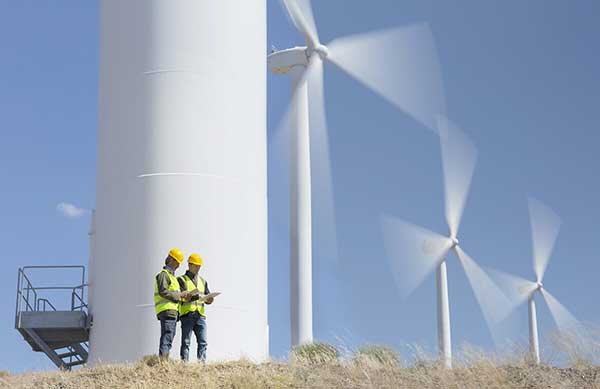
Saudi Arabia’s 400-MW wind farm, Dumat al-Jandal, was successfully connected to the grid and is expected to cut carbon emissions by nearly 1 million tons annually in that country. The farm consists of 99 turbines that each have the potential to power 70,000 homes.
The utility-scale wind project is being implemented by EDF Renewables and Masdar.
The project cost $500 million and is expected to contribute $150 million to Saudi Arabia’s GDP.
The site at Dumat al-Jandal was chosen because studies showed there was significant wind capacity at the site. The Saudi kingdom has set the goal of obtaining half of its electricity from renewable sources by 2030.
The wind farm project is part of the Saudi diversification strategy to lessen reliance on fossil fuels under a Vision 2030 reform plan.
New Coal Power Plant Explodes
An $8.3 billion coal power plant that has just opened in South Africa was taken offline within a week after an explosion occurred. The state utility Eskom said no injuries were reported.
The Medupi Power Station is one of the world’s largest coal power plants and was finally completed after more than a decade of construction delays and cost overruns. It has the capacity to supply more than 4,700 MW of electricity.
South Africa continues to rely on coal for about 75% of its energy needs.
Eskom’s preliminary investigation into the explosion suggested that some employees failed to adhere to standard procedure while seeking to uncover a leak at the Medupi generator, which led to the explosion. The employees were using hydrogen and carbon dioxide to carry out the activity.
Those employees have been placed on “precautionary suspension” until the investigation into the explosion is completed.
Trinidad and Tobago Announces Plans for EVs
Trinidad and Tobago’s Ministry of Planning announced that the country is working on obtaining funding for electric vehicle chargers, as the country seeks to honor its commitments under the Paris Agreement.
The Caribbean country has committed to a 15% reduction in greenhouse gas emissions in its transport, electricity, and industrial sectors by 2030, as part of its Nationally Determined Contributions under the Paris Agreement.
Officials in that country say plans for greater adoption of electric vehicles are at an advanced stage.
Opinion writer: Jewel Fraser
The opinions, beliefs, and viewpoints expressed by the various authors do not necessarily reflect the opinions, beliefs, or viewpoints of Interactive Energy Group, LLC (IEG) or its parent companies or affiliates and may have been created by a third party contracted by IEG. Any content provided by the bloggers or authors are of their opinion and are not intended to malign any individual, organization, company, group, or anyone or anything.
Brought to you by energysavings.com
All images licensed from Adobe Stock.
Featured image: