
Key Takeaways
- Power-to-X is when electricity, typically from renewable sources, is converted into other energy sources like hydrogen and jet fuel. The converted energies can more easily be stored long-term and transported to where they’re most needed.
- The “X” in Power-to-X accounts for all the possible end products after the conversion. If the final product is known, it can replace the “X” (e.g., Power-to-Hydrogen).
- Power-to-X can help stabilize the electric grid, prevent power outages, and reduce fossil fuel needs. Fuels like hydrogen also don’t release CO2 into the air, so they don’t contribute to greenhouse gas emissions.
Did you know that without ways to store renewable energy, all energy not used in the moment gets wasted? Electric service providers even stop generating renewable energy when there’s more supply than demand to avoid overloading the grid.
While batteries have helped store renewable power, they only store electricity for a few hours to days. Power-to-X is an alternative long-term storage solution that helps reduce energy waste and lets businesses use energy products in multiple ways. It can even create carbon-free energy that releases no greenhouse gases when burned. Here’s a closer look at everything you need to know about Power-to-X.
What is Power-to-X?
Power-to-X is the process of converting extra electricity generated from renewable sources to other energy forms that are easier to store, transport, and use in different industries. Wind and solar energy are the most common renewable sources in Power-to-X conversions.
The “X” in the name shows that there are various possibilities for energy end products, such as hydrogen, methane, and heat. If the power is converted into hydrogen, you might see Power-to-Hydrogen instead, or PtH. Power-to-X can be abbreviated as P2X, PtX, or P2Y.
 Image source: iStock by Getty Images | Creation of icons and illustrations
How Does Power-to-X Work?
In general, P2X takes excess renewable energy and sends it to an electrolyzer to make and store fuel for later use.
For example, windy conditions can cause wind turbines to generate extra electricity. To keep the surplus energy from being lost, it either needs to be directly stored for short-term use, such as in a battery, or sent to an electrolyzer to convert it into other fuels for long-term storage.
The electricity is sent to an electrolyzer, providing the power necessary to create a different energy form. If in our example, we wanted to create hydrogen, the electrolyzer would split water into its essential components: hydrogen (H2) and oxygen (O2). The hydrogen is stored as fuel, while the oxygen is released into the air.
The hydrogen is then compressed and stored in tanks or underground caverns. Then, it’s taken out when needed. For example, a factory might use the stored hydrogen in a furnace when it needs high-temperature heat, or it may run the hydrogen through a fuel cell to make electricity.
Enter your ZIP Code and compare electricity rates
How Does Power-to-X Help With Energy Storage and Grid Stability?
Power-to-X captures electricity that would otherwise be lost and stores it for later use. When wind turbines or solar energy farms make more energy than the electric grid needs at that moment, power providers have to stop or reduce renewable energy generation. Otherwise, that energy could overload or destabilize the grid.
Taking this energy and storing it in different forms helps the grid in various ways. For example, electric companies can use the stored energy in peak seasons like winter and summer to keep up with consumer demands and avoid power outages. It can also smooth out grid fluctuations at other times of the year to ensure the grid is always stable.
Other ways stored energy is helpful include:
- Reduced need for curtailing energy, making better use of energy generated from renewable sources
- Can be transported through existing transmission lines, avoiding the costly process of laying new lines
What Are the Key Pathways in Power-to-X?
Surplus electricity usually turns into hydrogen, synthetic liquid fuels, heat, or chemicals. It allows the electricity to be used as fuel in a variety of industries, even ones that don’t use the electricity directly, such as the steel production or aviation industry. Here’s a closer look at the key pathways in Power-to-X.
Power-to-Hydrogen
After an electrolyzer splits water into hydrogen and oxygen, the hydrogen is stored and used as fuel or in industrial processes. Hydrogen produces only heat and water vapor when burned — no CO2 emissions.
The hydrogen can also be used again in other Power-to-X pathways. Texas’s abundant renewable resources lend themselves well to green hydrogen production.
Power-to-Gas
The hydrogen produced in the above process can be combined with CO2 to make synthetic methane. You can then burn this synthetic gas like natural gas or use it in existing gas pipelines.
Power-to-Liquids
Hydrogen and CO2 can also make synthetic liquid fuels like methanol, diesel, and jet fuel.
Power-to-Heat
Surplus electricity is directly converted into high heat for industrial processes requiring it, such as food processing plants and paper mills. It could also be used in large central heating facilities that heat entire neighborhoods or cities.
Power-to-Heat is a much cleaner alternative to burning fossil fuels for heat because no greenhouse gases are emitted if the electricity in comes from renewable sources.
Power-to-Chemicals
Renewable electricity in Power-to-Chemicals produces products like ammonia or methanol, which are valuable chemical products useful in many industries.
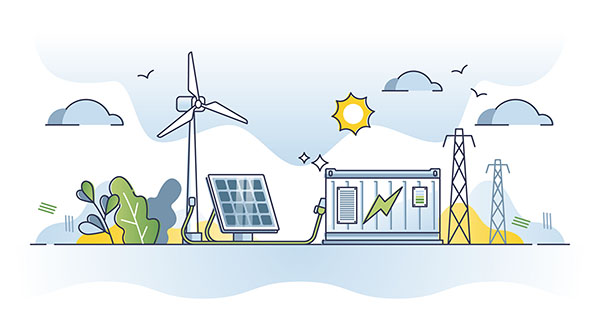 Image source: iStock by Getty Images | VectorMine
Traditional Electricity Storage vs. Power-to-X: What’s the Difference?
Power-to-X allows greater flexibility in storing energy than traditional energy storage systems like batteries. Below is a graph summarizing how the two compare. [1][2]
| Traditional Electricity Storage (e.g., Batteries) | Power-to-X | |
| Storage Duration | Short to medium-term (from hours to days) | Medium to long-term (from days to months) |
| Energy Density | Lower kWh/kg | Higher kWh/kg |
| Round-Trip Efficiency | Higher (70%-90%) | Lower (<37%; depends on pathway) |
| Scalability | Limited by material resources | More scalable because uses abundant elements like water |
| Application Flexibility | Returns only electricity | Produces a variety of types of energy for multiple sectors |
While electric companies use stored hydrogen and synthetic fuels as backup power sources or to generate electricity through turbines or fuel cells, batteries are still an integral part of stabilizing the grid and balancing demand.
Power-to-X is generally better when long-term storage or high-heat processing is needed. It’s also a good fit for sectors needing direct use of fuels instead of electricity.
Is Power-to-X Efficient?
P2X loses much of its initial energy in the conversion process, but it can be stored longer and used in more ways. It can also be transported over long distances through pipelines and even ships if converted into liquids. While batteries are very efficient at storing energy, they only hold it temporarily.
Converting electrical energy into other forms is more about utility than efficiency, since many industries need different types of energy for their tasks. Better electrolyzer designs and placement closer to the energy source are just two ways Power-to-X conversions can become more efficient.
How Does Power-to-X Benefit the Environment?
Power-to-X benefits the environment by reducing our dependency on fossil fuels and providing cleaner air in industrial facility zones. While some Power-to-X pathways still release CO2 into the atmosphere, others, like Power-to-Hydrogen, don’t. Fewer CO2 emissions are key to slowing climate change and reducing air pollution.
And because we’re using less fossil fuels, there’s also less water pollution. Gas and oil extraction often pollute ocean waters and hurt marine life. There’s also less of an impact on land, since extracting fossil fuels usually leaves behind toxic byproducts in the soil or can require large areas of trees to be cut down and removed.
Is Power-to-X Scalable?
Power-to-X is scalable, but we have several challenges to address before it can be widely used. Since hydrogen and synthetic fuels are still more expensive than natural gas and diesel, they’re less advantageous for businesses needing these fuel sources. However, costs for hydrogen and synthetic fuels are dropping, potentially making them a more attractive alternative.
To use Power-to-X on a large scale, we’d also need abundant renewable energy. Even though Texas, for instance, has a lot of wind and solar energy generators, diverting enough for Power-to-X conversions is still challenging. The state would need even more renewable energy generators to scale Power-to-X.

female engineer working outdoor with safety at wind turbines clean energy power station background, worker people with renewable energy technology for future concept.
Image source: iStock by Getty Images | coffeekai
How Are Governments Helping Power-to-X Adoption?
Several government subsidies and tax incentives are helping to make Power-to-X more mainstream. For example, the U.S. Inflation Reduction Act (IRA) offers up to $3/kg for clean hydrogen production, as well as production and investment tax credits. [3][4]
The Department of Energy also has an $8 million hydrogen hub program to help produce, distribute, and use clean hydrogen. [5] The goal of the program is to reduce carbon emissions and support clean energy infrastructure.
Powering the Future with Power-to-X
Power-to-X’s goal is to capture, store, and use energy that would otherwise be lost. Texas, with its rich wind, sun, and infrastructure, could be on the horizon of widespread adaptation of Power-to-X. It won’t replace all of the state’s energy needs overnight, but moving toward a cleaner,
Sources
- Sandia National Laboratories. “CHAPTER 11 HYDROGEN ENERGY STORAGE.” Accessed March 29, 2025. https://www.sandia.gov/app/uploads/sites/163/2022/03/ESHB_Ch11_Hydrogen_Headley.pdf
- ScienceDirect. “Efficiency and optimal load capacity of E-Fuel-Based energy storage systems.” June 2023. https://www.sciencedirect.com/science/article/pii/S2666792423000197
- U.S. Department of Energy. “Clean Hydrogen Production Tax Credit (45V) Resources.” January 3, 2025. https://www.energy.gov/articles/clean-hydrogen-production-tax-credit-45v-resources
- United States Environmental Protection Agency. “Summary of Inflation Reduction Act provisions related to renewable energy.” Accessed March 29, 2025. https://www.epa.gov/green-power-markets/summary-inflation-reduction-act-provisions-related-renewable-energy
- U.S. Department of Energy. “Funding Notice: Regional Clean Hydrogen Hubs.” Accessed March 29, 2025. https://www.energy.gov/oced/funding-notice-regional-clean-hydrogen-hubs
Brought to you by energysavings.com
All images licensed from Adobe Stock.