
Texas has a crowded field of comparison sites all promising to find you a better rate, and one of them is Choose Texas Power. This guide weighs what the two sites offer, where they overlap, and where they differ, so you can decide which one suits the way you shop.
EnergySavings.com vs. Choose Texas Power: Switching Energy Suppliers
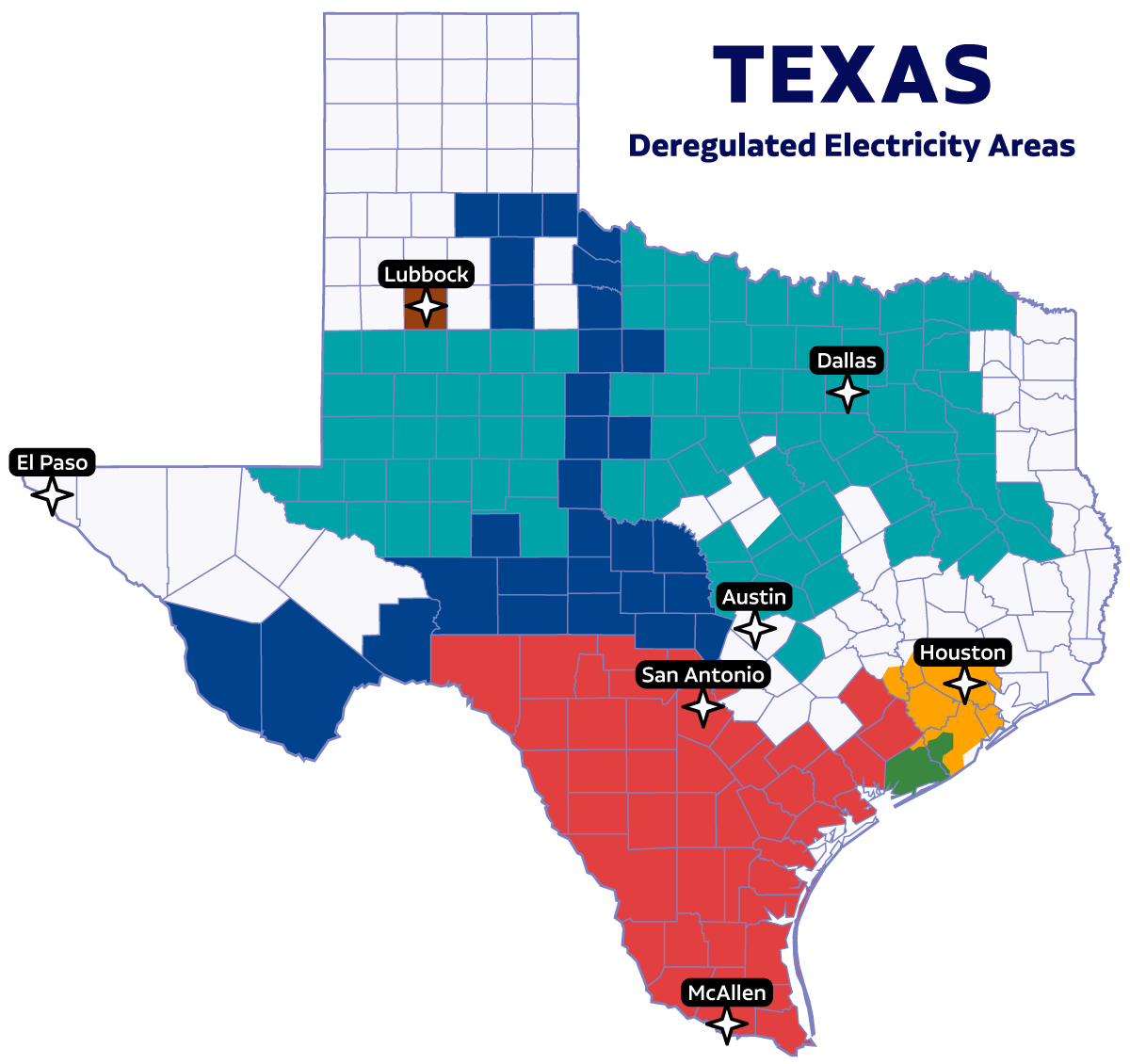
Texas runs a deregulated energy market, and roughly 85% of the state’s residents can choose their own electricity supplier.1 Businesses in applicable service areas can switch too. The savings usually come from one place: leaving a plan whose promotional term has expired, since expired fixed-rate contracts typically roll to a higher month-to-month rate.2
The complication is scale. Texas has more than 140 retail electric providers (REPs) registered with the state,3 and a single provider often runs a dozen or more plans that differ only in term length and usage thresholds. For a single address, that can leave shoppers sorting through hundreds of plans. Comparison sites make it easier to see what’s available and narrow down your choices.
Note that the Public Utility Commission of Texas (PUC or PUCT) chooses the REP for anyone living or operating a business in a regulated service area in Texas.
EnergySavings.com vs. Choose Texas Power: Summary Company Information
Below is a summary of who runs each site.
EnergySavings.com
- Operated by Interactive Energy Group LLC
- Headquartered in Houston, Texas
- PUCT Registration #BR1903985
- Texas electricity only, for homes and businesses
- Over 20 years of affiliate experience in the Texas retail energy market
- Publishes Texas energy news, rate analysis, and efficiency guides
Choose Texas Power
- Operated on behalf of Save On Energy, LLC, a Red Ventures company
- Corporate headquarters in Fort Mill, South Carolina, with an Austin, Texas office
- PUCT Registration #BR1903196
- Texas electricity for homes and businesses
- States it has helped over 1 million Texans find energy plans
- Publishes provider reviews, a glossary, and a blog called The Current
EnergySavings.com vs. Choose Texas Power: How Similar Are They?
On the surface, the two sites look interchangeable. Where they part ways is in how each one builds its plan list.
EnergySavings.com vs. Choose Texas Power: The Similarities
EnergySavings.com vs. Choose Texas Power: The Similarities
- Runs free of charge as an online energy marketplace
- Holds a PUCT broker registration rather than a provider license
- Searches by ZIP code, with filters and estimated monthly bills
- Covers residential and business electricity
- Publishes location pages for Texas cities and for utilities like Oncor, CenterPoint, and TNMP
- Explains how Texas deregulation works
- Guides you through Electricity Facts Labels, early termination fees, and fixed versus variable rates
- Breaks down the state’s Power to Choose website
EnergySavings.com vs. Choose Texas Power: What’s the Difference?
EnergySavings.com pulls its listings from Power to Choose, the state’s official database, then narrows them to established providers. We refresh from a daily snapshot, run the average on English-language plans, and flag that rates can shift between morning and afternoon. Choose Texas Power’s list of plans come from providers that partner with the site.
Where a site gets its plans affects what you’ll actually see and choose:
- Plan lineups. Choose Texas Power lists roughly a dozen providers we don’t carry (4Change, Rhythm, Green Mountain, and others), we list five it doesn’t (Just Energy, Amigo, and Tara among them), and six appear on both (APG&E, Constellation, Gexa, Payless Power, Reliant, and TXU).
- Enrollment. EnergySavings.com sends you to the retail provider to sign up, so your account sits with the provider from the first click. Choose Texas Power enrolls you on its own site or by phone. Either way the provider bills you and takes your calls afterward, since a broker can’t touch your account once you’ve enrolled.
- Provider ratings. Choose Texas Power scores each provider out of five, with written reviews covering rate structure, contract terms, fees, and reputation. EnergySavings.com doesn’t rate providers, since its data comes from the state’s neutral listing rather than a curated partner set.
- Extra tools. Choose Texas Power adds a quiz that suggests plans from your answers. EnergySavings.com publishes utility outage numbers, PUCT contacts, and a monthly report tracking where Texas rates are heading.
- Business coverage. Choose Texas Power runs segmented pages for several commercial customer types; EnergySavings.com routes business shoppers to a specialist.
EnergySavings.com vs. Choose Texas Power: Which States Do They Serve?
For the service compared here, both are Texas-only. Neither offers residential plans in other states, and neither handles natural gas in Texas.
The corporate footprints differ, though. Choose Texas Power’s parent, Red Ventures, runs comparison sites across many deregulated markets through other brands, while EnergySavings.com has focused on Texas electricity from the start, with affiliates in this one market for over 20 years.
EnergySavings.com vs. Choose Texas Power: How Do They Make Money?
EnergySavings.com and Choose Texas Power are both free to use. Both earn revenue the same basic way, which is that electricity companies pay them when shoppers sign up.
Choose Texas Power states this directly. Providers compensate the site when customers enroll online or over the phone, which is what keeps the marketplace free to use. The site publishes a monetization disclosure page and a set of editorial guidelines explaining that partners don’t direct its editorial content.
EnergySavings.com works on the same commission model. Companies whose plans appear on our site can pay us when a shopper enrolls, and we publish energy information independently of those commercial relationships.
Do EnergySavings.com and Choose Texas Power Review Energy Companies?
Yes, but not in the same way.
Choose Texas Power publishes rated reviews of the providers on its marketplace, scoring each out of five and naming what each is best suited for. Recent picks put TXU Energy, 4Change Energy, Express Energy, Veteran Energy, and Gexa Energy at the top. The reviews also carry criticism, noting customer complaints about billing confusion at some providers and weaker customer service scores at others. Its articles carry named authors, editors, and an updated date.
EnergySavings.com publishes company pages for the providers on our marketplace, covering plan types, contact details, and background information. We score providers on a rating scale in order to share their strengths and weaknesses with customers.
EnergySavings.com vs. Choose Texas Power: Which Has Lowest Prices?
No comparison site can honestly claim to always have the lowest rate. Providers update their plans against a wholesale market that changes constantly, and they refresh their advertised plan cards on their own schedules, so the cheapest plan for your ZIP code can differ between sites. On any given day either site might show a lower headlined rate.
The more useful question is whether the cheapest advertised rate is actually the cheapest plan for your household, and often it isn’t.
Price Comparison Websites: What to Know Before Starting
- Kilowatt-hours (kWh): Every plan is advertised in cents per kWh. Pull your last several bills to work out your typical monthly usage.
- Bill credits and minimum usage: Many of the lowest advertised rates in Texas depend on hitting a usage threshold. Plans showing 7.2 cents per kWh often carry a $125 credit that only applies in months you use 1,000 kWh or more. The advertised rate assumes you receive that credit every month. However, in a month where you use 950 kWh, the credit disappears.
- Fixed, variable, or indexed: Fixed rates remain consistent for the contract term and usually come with an early termination fee. Variable rates provide flexibility but change with the market. Indexed rates fluctuate with a published wholesale formula, so the risk sits with you rather than the provider.
Also consider whether you want a time-of-use plan, whether renewable content matters to you, and what deposit you’d be asked for.
What is the Power to Choose Website?
Power to Choose is the PUCT’s official comparison site. It carries every certified retail electric provider in the state, with no featured deals or sales tactics.
Power to Choose ranks plans by their advertised rate at 1,000 kWh. Once you search at your own usage level, the order of plans will update. While easy to use, commercial sites often show a curated subset of the market.
Our Power to Choose guide walks through the state site step by step.

EnergySavings.com vs. Choose Texas Power: A Price Comparison
We ran the same Houston ZIP code through both sites to see what each one turned up.
EnergySavings.com vs. Choose Texas Power: Using Their Search Tools
EnergySavings.com starts with your utility company, then lets you filter by rate type, term length, and renewable percentage, comparing up to six providers side by side. The comparison chart uses data from Power to Choose. Enter a ZIP code to see plans available in your specific area.
Choose Texas Power offers two routes. You can enter a ZIP code and view advertised rates directly, or take a short quiz to see matches tailored to your specific needs. Rates are timestamped.
Comparison of Rates: EnergySavings.com vs. Choose Texas Power
* All rates above are accurate as of 11/18/2026 for zip code 77003 based on 1,000 kWh of usage. Rates may have changed since this date. For the most up-to-date rates in your area, please enter your zip code. You can obtain important standardized information that will allow you to compare this product with other offers. Contact the respective provider.
- Advertised rates from 7.0 to 19.0 cents per kWh across its featured plans7
- Contract terms from 6 to 36 months
- Fixed-rate, bill credit, prepaid, and renewable plans
- Lowest advertised plan: APG&E SimpleSaver 11, an 11-month fixed rate at 7.0 cents per kWh
- 18 providers listed on the marketplace
EnergySavings.com vs. Choose Texas Power: What the Energy Deals Mean
The cheapest plans on Choose Texas Power’s Houston list were all bill credit products. The 4Change Maxx Saver Value 12, the Express Energy Flash Value 12, and Gexa’s Saver Plus 12 clustered at 7.2 cents per kWh, and each one carries a $125 credit that only posts at 1,000 kWh or more.
Plans without a usage threshold advertised higher rates. TXU’s Smart 1000 Saver 12 showed 10.9 cents per kWh and Reliant’s Power Savings 12 showed 13.2 cents. For an apartment that runs 700 or 800 kWh in a mild month, either of those can cost less over a year than a 7.2-cent plan whose credit never posts.
EnergySavings.com vs. Choose Texas Power for Business Customers
EnergySavings.com runs business shopping through a form. You fill in your business details and your estimated monthly bill, and one of our energy experts calls you back with options.
Choose Texas Power works much the same way, with a quote form and a commercial phone line, and adds pages aimed at small businesses, property managers, merchants, and schools and churches. For self-serve comparison it points businesses to a separate site, PowerHQ.com.
Either way, expect to supply usage details and speak to someone. Commercial contracts turn on usage patterns, meter type, and load, which is why neither site quotes a business rate the way it quotes a home rate.
How to Contact EnergySavings.com and Choose Texas Power
The EnergySavings.com customer support team handles inquiries by email. We publish utility outage numbers and PUCT contact details for problems we can’t fix ourselves.
Choose Texas Power lists a corporate phone line, staffed weekdays 7:00 a.m. to 9:00 p.m. and weekends 9:00 a.m. to 8:00 p.m. Central, plus an online support center.
EnergySavings.com vs. Choose Texas Power: Who Has the Best Blog?
EnergySavings.com focuses on Texas energy news, rate analysis, and advice. Recent pieces cover how the Texas power grid works, how to read an Electricity Facts Label, and ways to cut household usage.
Choose Texas Power’s library leans toward provider reviews, plan-type explainers, and a glossary of energy terms, which makes it a useful place to read up on a single company before enrolling.
Which library of content helps more depends on whether you’re tracking the market or evaluating a specific provider.
EnergySavings.com vs. Choose Texas Power: In Conclusion
Both are reputable tools for the same task. Choose Texas Power provides a nice starting point if you want to see provider ratings before you commit, or if you’d rather have someone take you through the enrollment process by phone.
EnergySavings.com is the better fit if you’d rather compare plans yourself against the state’s own Power to Choose data and enroll directly with the electricity company.
Neither site lists every plan sold in Texas, so check what you find against Power to Choose and read the Electricity Facts Label before you sign. Whichever route you take, ask yourself these questions before switching electricity suppliers.
Energysavings.com is the tool to select your next retail electric provider.
With affiliates having over 20 years of experience in the retail industry, we can make your life easier when it comes to choosing a new retail electricity provider. Enter your zip code below and see your energy choices!
1. Electric Reliability Council of Texas. “Retail Market Brief.” Accessed Sept,, 2026. https://www.ercot.com/news#:~:text=The%20Electric%20Reliability%20Council%20of,the%20electricity%20used%20in%20Texas
2. Public Utility Commission of Texas. “Choosing an Electric Plan.” Accessed Sept 2026. https://www.puc.texas.gov/consumer-help/electricity/electric-plan
3. Public Utility Commission of Texas. “Retail Electric Provider (REP) Directory.” Accessed Sept, 2026. https://www.puc.texas.gov/industry/electric/directories/rep/alpha_rep.aspx
4. Public Utility Commission of Texas. “Aggregator and Broker Registration,” 16 Texas Administrative Code Section 25.107. Accessed Sept, 2026. https://www.puc.texas.gov/agency/rulesnlaws/subrules/electric/25.107/25.107.pdf
5. Public Utility Commission of Texas. “Retail Electric Provider (REP) Directory: Interactive Energy Group LLC, Broker Registration #BR190398.” Accessed Sept, 2026. https://www.puc.texas.gov/industry/electric/directories/rep/alpha_rep.aspx
6. Public Utility Commission of Texas. “Retail Electric Provider (REP) Directory: Save On Energy, LLC, Broker Registration #BR190319.” Accessed Sept, 2026. https://www.puc.texas.gov/industry/electric/directories/rep/alpha_rep.aspx
7. Choose Texas Power. “Houston Electricity Rates.” Accessed Sept, 2026. https://www.choosetexaspower.org/electricity-rates/houston